
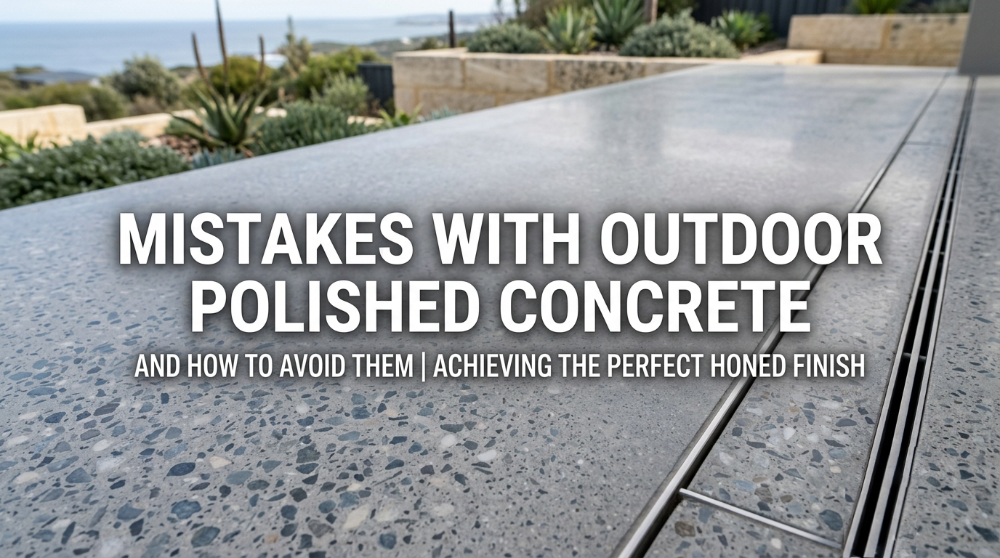
Critical Errors in Specifying and Executing Outdoor Concrete
When planning an alfresco project, understanding common **mistakes with outdoor polished concrete** is essential, as this premium architectural material has solidified its position across Australia. However, because of its surging popularity, a wave of inexperienced contractors have entered the market, offering budget services without the specialised knowledge, industrial machinery, or technical skills required to deliver a flawless, durable result.
When specifying a finish for high-exposure environments, avoiding major mistakes with outdoor polished concrete is crucial to securing an asset that lasts. Diamond Grind specialise in precision substrate preparation, resurfacing, and refining concrete surfaces to guarantee an exquisite, weather-resistant finish. Read on to discover the top three execution errors and how to avoid them.
How Existing Slabs Impact Mistakes With Outdoor Polished Concrete
One of the most frequent mistakes with outdoor polished concrete is assuming that any existing concrete slab can simply be ground down and polished to perfection. If you are working with an older, pre-existing slab, you cannot select the base cement colour or the specific aggregate distribution—the final look is entirely dictated by what was originally poured decades ago. A slab poured for a simple shed or basic pathway rarely has the uniform aggregate distribution required for an even, premium finish.
Furthermore, if you intend to remove old outdoor tiles to expose a polished surface underneath, you must account for years of environmental exposure. Over time, heavy rain, organic debris, bleach, and harsh cleaning chemicals often leach directly through porous tile grout lines, deeply staining the underlying concrete matrix. While these factors do not completely prevent the creation of a stunning polished concrete floor in your outdoor area, they will heavily dictate your final colour coordination and aggregate exposure level. Failing to core-test the slab beforehand is a major contributor to unexpected **mistakes with outdoor polished concrete** outcomes.
Selecting the Wrong Process for High-Exposure Areas
Not all concrete refinement processes are engineered equal. Mechanically Polished Concrete (MPC) relies on chemical densifiers and progressive diamond grinding stages to achieve its sheen, whereas Honed Concrete utilises a topical clear coat or penetrative sealer. Specifying a glass-like high-gloss finish poolside is an absolute safety hazard, as it lacks the wet pendulum slip resistance required by strict Australian building regulations. Selecting an indoor finish for an outdoor zone is one of the most dangerous **mistakes with outdoor polished concrete** a property owner can make.
Additionally, selecting non-UV-stable sealants or standard epoxies for an alfresco zone will cause the surface to yellow, chalk, and delaminate rapidly under intense Australian sunlight. Avoiding these costly **mistakes with outdoor polished concrete** means ensuring your flooring specialist explains your specific slip-rating requirements, maintenance re-sealing intervals, and tailored pricing options before work begins. Outdoor areas demand specialized UV-resistant polyurethane or polyaspartic sealers to combat harsh solar exposure.
Commissioning an Unvetted Contractor for Complex Demands
No two outdoor concrete slabs respond to diamond tooling in the identical way; variation in concrete hardness, curing history, and moisture levels requires real-time adjustment. Partnering with a general builder or an unvetted contractor instead of a dedicated concrete polishing firm often leads to micro-cracking, uneven aggregate exposure, and early floor failure. These structural flaws represent some of the most expensive mistakes with outdoor polished concrete to repair, often requiring complete resurfacing.
If you want to eliminate risks and secure a flawless architectural finish for your outdoor entertainment space, courtyard, or commercial pavilion in the Sydney Metro and greater NSW areas, Diamond Grind is your trusted partner. We deliver a premium range of concrete polishing, high-performance polyurethane cement, and durable epoxy resin systems tailored to withstand the elements. Contact us today for a technical consultation.
Compliance and Testing: Doing It Right the First Time
To avoid dangerous mistakes with outdoor polished concrete, professional installers must cross-reference all finish textures with the Standards Australia guidelines for slip resistance. For external pathways, ramps, and swimming pool surrounds, the surface texture must maintain an appropriate pendulum classification (typically P4 or P5) to ensure stability during rain events.
Our team achieves this by applying specialised anti-slip aggregates or utilising specific hone-grinding sequences that leave the concrete safely slip-resistant without losing its premium architectural appeal. True asset durability is a product of safety compliance, meticulous machine profiling, and verified material execution. By paying attention to these engineering benchmarks, commercial operators can completely bypass the typical durability pitfalls and structural **mistakes with outdoor polished concrete** installations.
Advanced Surface Engineering: Managing Slopes and Drainage
An often overlooked factor that leads to prominent mistakes with outdoor polished concrete is ignoring the slab’s existing fall and drainage capabilities. Unlike indoor environments where floors are perfectly level, outdoor surfaces must actively shed stormwater away from the building’s foundations. When an inexperienced team grinds the surface unevenly, they risk creating micro-depressions where rainwater can pool. Stagnant puddles on a honed surface not only create unsightly mineral stains over time but also accelerate the breakdown of protective clear sealants.
A professional concrete contractor meticulously maps the contours of your external slab before any diamond tools touch the surface. By understanding the natural hydrology of your alfresco area, we preserve the critical grading while refining the texture. This advanced engineering ensures that water flows seamlessly off the slab, protecting both the architectural beauty of your floor and the underlying structural integrity of your property.
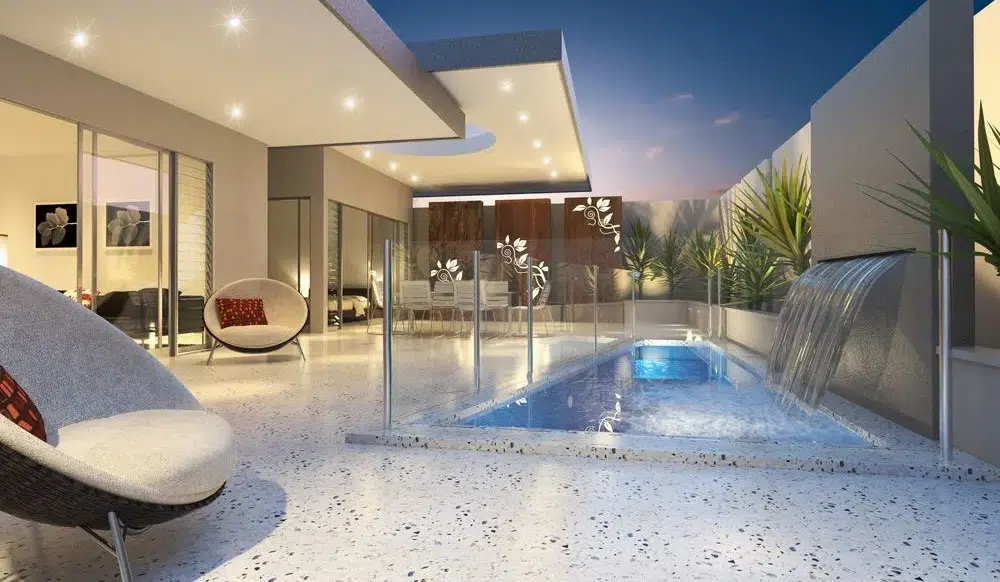
Spectacular results or common mistakes?
We will let you decide.
FAQ,s

Is mechanically polished concrete suitable for external alfresco areas?
No, specifying true mechanically polished concrete (MPC) outdoors is one of the most common mistakes with outdoor polished concrete. MPC relies on high-gloss chemical densifiers and progressive diamond polishing stages that become exceptionally slippery when wet. For external pathways, pool surrounds, and alfresco zones, a honed concrete finish with an appropriate penetrative sealer and anti-slip grit is the required, compliant choice.
Can you polish an old concrete slab that previously had tiles installed?
Yes, but you must be careful to avoid aesthetic mistakes with outdoor polished concrete layouts. Over many years, moisture, organic matter, and aggressive tile cleaners can leach directly through the porous grout lines and permanently discolour the concrete matrix beneath. While a professional team can successfully grind and hone the surface, the final look will be heavily influenced by these historic ghosting stains and the existing slab’s random aggregate distribution.
How do you prevent polished concrete from yellowing under intense Australian sunlight?
Surface discoloration occurs when contractors mistakenly apply standard interior epoxy or non-UV-stable topical sealers to external zones. To safeguard your architectural asset against harsh UV exposure, professional installers utilise premium, non-yellowing polyaspartic or aliphatic polyurethane clear coatings. Specifying the correct, weather-resistant chemical formulation is vital to avoiding early delamination and costly surface yellowing.
Why does rainwater pool on some poorly executed outdoor honed concrete floors?
Water pooling is a direct result of improper substrate analysis and uneven machine-grinding sequences. Unlike level indoor spaces, external concrete must maintain a precise gradient to actively direct stormwater away from structural foundations. When inexperienced teams fail to map the slab’s natural hydrology before grinding, they inadvertently create micro-depressions. These low spots trap stagnant water, which degrades protective sealers and causes unsightly mineral staining.
✅ Let's Talk — DiamondGrind
100% free consultation — no commitment required.