

GMP Flooring: Ensuring Quality and Compliance in Manufacturing
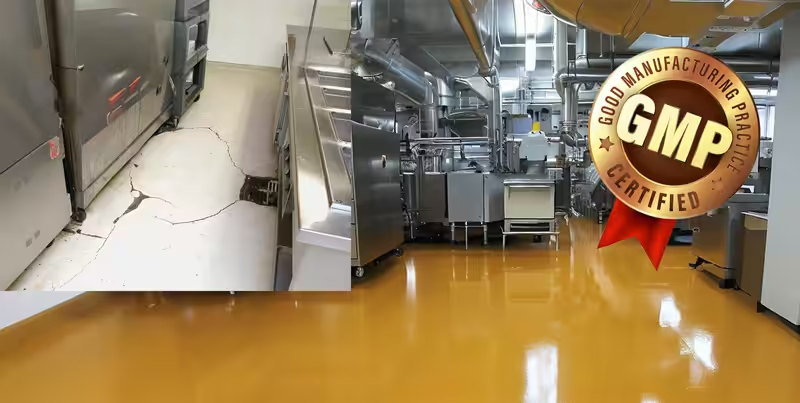
Good Manufacturing Practice (GMP) standards are non-negotiable in industries such as pharmaceuticals, medical device manufacturing, food production, and biotechnology. In these highly regulated sectors, maintaining an ultra-clean, hygienic, and sterile environment is critical to preventing product contamination. A fundamental component of achieving regulatory compliance is your facility’s floor. At Diamond Grind, we understand the strict operational demands of sterile environments and specialise in delivering world-class GMP flooring solutions.
Why Compliant GMP Flooring is Crucial for Regulatory Audits
To pass stringent audits by authorities like the Therapeutic Goods Administration (TGA) or Food Standards Australia New Zealand (FSANZ), your facility’s surfaces must satisfy strict environmental criteria. True GMP-compliant flooring is deliberately engineered to provide five key operational safety characteristics:
- Flawless Cleanability: To prevent cross-contamination, floors must withstand rigorous daily decontamination routines. Materials like resin coatings create smooth surfaces that allow sanitisers to work with maximum efficacy.
- Impervious, Non-Porous Barriers: Microscopic pores in raw substrates act as breeding grounds for bacteria, bio-burden, and fungal spores. Our systems seal the slab completely, preventing contaminants from penetrating the floor.
- Seamless Installation & Coving: Eliminating open joints, grout lines, and expansion seams removes the crevices where dirt and pathogens safely hide from standard cleaning protocols.
- Industrial-Grade Durability: Manufacturing plants are punishing environments featuring heavy foot traffic, forklift wheels, vibrating machinery, and localized chemical exposure. A compliant floor must resist cracking, chipping, or flaking, as loose particles pose a severe contamination risk.
- Certified Slip Resistance: While maintaining sterile conditions is vital, workplace safety remains a top priority. Our floors are customised to deliver exceptional slip-resistance to safeguard your technical team.
High-Performance GMP Flooring Systems by Diamond Grind
At Diamond Grind, we don’t believe in a one-size-fits-all approach. We offer a tailored matrix of premium GMP flooring systems engineered to match the specific cleanroom classifications and zoning of your manufacturing facility:
1. Polyurethane Cement (PU Cement): The All-Purpose Industry Benchmark
For processing areas facing extreme thermal, physical, and chemical abuse, polyurethane cement is the ultimate option. It is an incredibly tough, chemical-resistant finish that handles thermal shock from hot water washdowns effortlessly. It prevents microbial growth naturally and remains completely intact under the most demanding manufacturing schedules.
2. Industrial Epoxy Coatings: Precision Cleanroom Protection
Our high-build epoxy flooring systems provide a perfectly flat, light-reflective, and seamless surface ideal for pharmaceutical compounding areas, laboratories, and packaging lines. Epoxy provides excellent mechanical resistance against chemical drops and forms an unbroken protective envelope over your structural concrete.
3. Advanced Polished Concrete: Sustainable Durability for Secondary Zones
For warehousing, dry raw material storage, and administrative corridors, polished concrete offers an exceptionally low-maintenance solution. Mechanically densified and polished using precision diamond-grit grinders, this dust-proof flooring handles heavy transport traffic for decades without requiring topical coatings that could eventually delaminate or flake.
Partnering with Sydney’s Compliance Specialists
When you choose Diamond Grind for your facility upgrade, you benefit from our unwavering commitment to quality, engineering precision, and strict regulatory adherence. Our experienced team ensures that every installation undergoes thorough substrate preparation, moisture testing, and meticulous detailing to guarantee your surfaces sail through your next regulatory audit seamlessly.
Secure Your Compliance and Quality Standards Today
Ensuring your flooring meets strict GMP standards is essential for maintaining a clean, safe, and fully compliant manufacturing environment. We highly recommend consulting relevant government guidelines, such as the TGA or FSANZ frameworks, to fully map out your cleanroom requirements. Let the elite team at Diamond Grind execute the physical solution.
For expert advice, custom technical specifications, or a comprehensive site quote for your facility, get in touch with our specialist team today. Let’s build a clean, compliant foundation for your business success.
FAQ,s

What makes a floor strictly GMP-compliant compared to standard commercial flooring?
Standard commercial flooring often features joins, grout lines, porous textures, or materials that can slowly degrade, outgas, or release microscopic particulate matter into the air. True GMP flooring must be entirely non-porous, seamless, and chemically inert. It must be capable of resisting heavy impacts and aggressive chemical washdowns without cracking, flaking, or eroding, as any breakdown of the flooring material directly introduces contamination risks into a sterile manufacturing environment.
Standard commercial flooring often features joins, grout lines, porous textures, or materials that can slowly degrade, outgas, or release microscopic particulate matter into the air. True GMP flooring must be entirely non-porous, seamless, and chemically inert. It must be capable of resisting heavy impacts and aggressive chemical washdowns without cracking, flaking, or eroding, as any breakdown of the flooring material directly introduces contamination risks into a sterile manufacturing environment.
Can your GMP flooring systems incorporate seamless wall-to-floor coving?
Yes, absolutely. In fact, seamless wall-to-floor coving is an essential requirement for high-grade GMP cleanrooms and pharmaceutical facilities. At Diamond Grind, we install custom epoxy or polyurethane coving that curves elegantly up the base of the wall, typically to a height of 100mm or 150mm. This entirely eliminates the 90-degree right angle where the wall meets the floor—a notorious dead zone where dirt, moisture, and bacteria gather out of reach of standard cleaning equipment.
Yes, absolutely. In fact, seamless wall-to-floor coving is an essential requirement for high-grade GMP cleanrooms and pharmaceutical facilities. At Diamond Grind, we install custom epoxy or polyurethane coving that curves elegantly up the base of the wall, typically to a height of 100mm or 150mm. This entirely eliminates the 90-degree right angle where the wall meets the floor—a notorious dead zone where dirt, moisture, and bacteria gather out of reach of standard cleaning equipment.
How well do epoxy and polyurethane cement floors handle aggressive chemical sanitisers and thermal washdowns?
Our industrial-grade epoxy and polyurethane cement systems are engineered specifically to withstand the harsh chemical environments of manufacturing plants. They are completely immune to standard cleanroom sanitisers, caustic washdown agents, alcohols, and acids. For facilities that utilise live steam or boiling water for sanitisation, we highly recommend our thick-layer polyurethane cement systems. Polyurethane cement shares a near-identical thermal expansion rate with the underlying concrete slab, meaning it won’t delaminate, blister, or crack during sudden, intense temperature spikes.
Our industrial-grade epoxy and polyurethane cement systems are engineered specifically to withstand the harsh chemical environments of manufacturing plants. They are completely immune to standard cleanroom sanitisers, caustic washdown agents, alcohols, and acids. For facilities that utilise live steam or boiling water for sanitisation, we highly recommend our thick-layer polyurethane cement systems. Polyurethane cement shares a near-identical thermal expansion rate with the underlying concrete slab, meaning it won’t delaminate, blister, or crack during sudden, intense temperature spikes.
How do Diamond Grind installations help our facility pass TGA or FSANZ regulatory audits?
Auditors look for any potential vectors for product contamination, with floor degradation being a major red flag. Diamond Grind helps you secure compliance by utilizing heavy-duty dustless diamond grinders to perfectly profile your concrete slab before application, ensuring our resin systems achieve an permanent, unbreakable mechanical bond. By delivering a flawless, ultra-smooth, seamless, and highly durable surface that simplifies environmental monitoring and validation, we eliminate the structural risks that trigger costly audit failures.
Auditors look for any potential vectors for product contamination, with floor degradation being a major red flag. Diamond Grind helps you secure compliance by utilizing heavy-duty dustless diamond grinders to perfectly profile your concrete slab before application, ensuring our resin systems achieve an permanent, unbreakable mechanical bond. By delivering a flawless, ultra-smooth, seamless, and highly durable surface that simplifies environmental monitoring and validation, we eliminate the structural risks that trigger costly audit failures.
✅ Let's Talk — DiamondGrind
100% free consultation — no commitment required.