
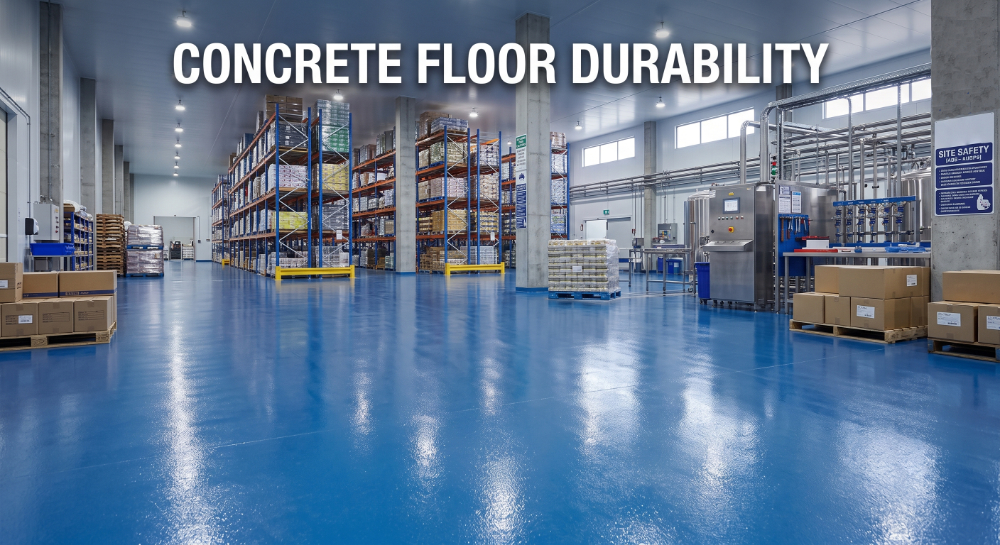
Concrete flooring is a popular choice across diverse Australian industries due to its foundational strength and inherent longevity. However, not all concrete floors are created equal; the **concrete flooring durability** of your installation is a direct reflection of substrate preparation quality, material grade, and the expertise of your installation team. Inferior products and poor surface preparation frequently lead to peeling, blistering, and dusting, resulting in costly repairs, extensive downtime, and significant workplace safety hazards.
A Tale of Two Floors: The True Cost of Cutting Corners
Imagine two Australian business owners eager to upgrade their operational space. One owns a high-throughput restaurant kitchen in Sydney, while the other runs a busy automotive fleet workshop in Melbourne. Both decide to invest in new resin flooring to enhance compliance, safety, and aesthetics.
The restaurant owner opts for a cheaper, unvetted contractor, while the garage owner chooses an established industrial firm like Diamond Grind. Fast-forward just a few months, and the restaurant owner is facing delaminating coatings, stubborn stains, and frequent re-applications that interfere with service. Conversely, the workshop owner enjoys a seamless, durable, and low-maintenance floor asset that handles forklift and heavy chemical loads daily.
This scenario perfectly highlights the vital importance of prioritising proven expertise and high-performance specifications for long-term **concrete flooring durability**.
Critical Mistakes That Destroy Concrete Flooring Durability
How Inferior Materials Impact Concrete Flooring Durability
While standard coatings might appear similar on paper, their chemical structure and cross-linking density differ wildly.
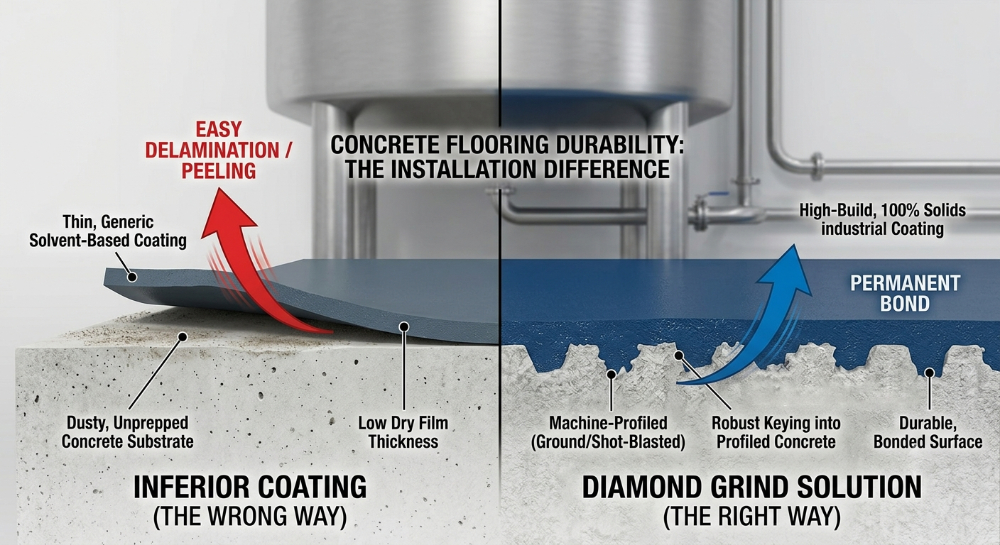
- With Epoxy Flooring: Low-cost “off-the-shelf” epoxy systems often contain higher volumes of solvents, leading to a thinner dry film and brittle topcoat. To ensure concrete flooring durability, you must specify 100% solids, industrial-grade epoxy capable of withstanding extreme abrasive wear and chemical attack without peeling.
- With Polyurethane Cement: Standard polyurethane concrete mixtures might create a rigid surface, but substandard cement often results in low density. High-quality Australian polyurethane cement provides a resilient surface with dynamic elasticity to handle thermal shock, essential for processing facilities.
- With Polished Concrete: Achieving a sleek, glass-like finish requires intricate multistage refinement. Utilising generic densifiers or inferior sealants creates a porous surface that dulls rapidly and absorbs oil or food stains, nullifying the maintenance advantages of polished concrete.
How Poor Installation Undermines Concrete Flooring Durability
Even the highest-grade resin will fail instantly if the surface is not prepared correctly.
- Inadequate Surface Preparation: Skipping steps like thorough grinding, shot-blasting, and priming leads directly to adhesion issues. Proper preparation must utilise specialised equipment to open the concrete’s pores and achieve the required surface profile.
- Ignoring Substrate Moisture (MVT): Concrete holds significant moisture-vapour that can push coatings off the surface. A professional team always tests the slab for moisture before application and utilises a specialised moisture-vapour barrier primer when necessary.
- Ignoring Local Environmental Conditions: Temperature and humidity drastically alter the curing kinetics of industrial resins. Failing to account for Sydney’s summer humidity or Melbourne’s sudden cold shifts can result in sticky, incomplete cures that destroy the floor’s durability and chemical resistance.
The Hidden Costs of Selecting Inferior Flooring
While the initial quote for premium industrial materials and expert installation may seem high, the long-term operational savings are profound. Inferior flooring is a temporary fix that results in persistent repairs, higher maintenance labour, and often, early complete replacement that doubles your total investment. Investing in certified **concrete flooring durability** ensures a safer, more efficient work environment with predictable long-term asset performance.
The Diamond Grind Commitment to Durability
At Diamond Grind, we focus on the foundational engineering necessary for long-term concrete flooring durability. Our expert team specialises in high-performance epoxy, polyurethane cement, and sophisticated polished concrete solutions customised to the unique physical and chemical demands of your industry. We prioritise thorough substrate testing, meticulous machine-based preparation, and precise material metering to guarantee that your new floor asset stands the test of time.
Invest in Quality Australian Solutions and Avoid Costly Regrets
Selecting the right specification and professional team is vital for the long-term reliability and compliant performance of your facility. Do not fall into the trap of accepting a cheap temporary solution that fails under pressure. Contact the experts at Diamond Grind today to schedule a comprehensive technical site assessment and discover how we can engineer proven **concrete flooring durability** into your facility. For deep-dive guides on different industrial coating specifications, explore our other blog posts.
FAQ,s

What is concrete laitance, and how does it affect concrete flooring durability?
Concrete laitance is a fragile, milky layer of fine particles and cement dust that rises to the surface as concrete cures. If an installer applies an industrial coating directly over laitance without machine-grinding it away first, the resin will bond only to this weak layer rather than the solid slab beneath. This is the absolute leading cause of premature peeling and completely destroys long-term concrete flooring durability.
Concrete laitance is a fragile, milky layer of fine particles and cement dust that rises to the surface as concrete cures. If an installer applies an industrial coating directly over laitance without machine-grinding it away first, the resin will bond only to this weak layer rather than the solid slab beneath. This is the absolute leading cause of premature peeling and completely destroys long-term concrete flooring durability.
How do professional installers ensure maximum adhesion for epoxy or polyurethane coatings?
Professional teams utilise industrial diamond grinders or shot-blasting machinery to open the concrete’s pores and remove surface contaminants. This mechanical profiling creates a rough texture—similar to coarse sandpaper—which allows the high-solids coating to deeply “key” or interlock into the slab. This mechanical and chemical bond prevents delamination and ensures optimal concrete flooring durability under heavy forklift traffic.
Why do some epoxy floors lose their gloss or become dull so quickly?
Rapid dulling or scratching typically happens when inferior, thin, solvent-based coatings are used instead of 100% solids, industrial-grade epoxies. Low-grade finishes lack the necessary cross-linking density to resist fine scratches and aggressive chemical cleaners. To preserve your floor’s aesthetic and concrete flooring durability, always specify premium coatings that are formulated specifically for your facility’s daily traffic and washdown routines.
How does moisture in the concrete slab impact the lifespan of a new floor coating?
ven fully cured concrete slabs breathe and emit moisture vapour. If a non-porous resin coating is applied over a slab with high moisture vapour transmission (MVT) without a specialised moisture barrier primer, trapped vapour pressure will build up. This pressure creates blisters, bubbles, and eventual peeling. Proper moisture testing is a vital step in engineering reliable concrete flooring durability.
✅ Let's Talk — DiamondGrind
100% free consultation — no commitment required.